In short
- A second brain is a folder of plain text files plus an AI assistant that reads and writes them. The notes are the memory. The assistant acts on them.
- Four layers: the vault, the rules file, the agent, the connections. The rules file is the product.
- In Fair Light runs on one every day: a planned morning, a voice note that updates five surfaces, a weekly review that writes back into the rules.
- Software: about the price of one AI subscription. The real cost is a month of attention.
- Three-page PDF at the bottom you can keep, print, or hand to someone who keeps asking what this is.
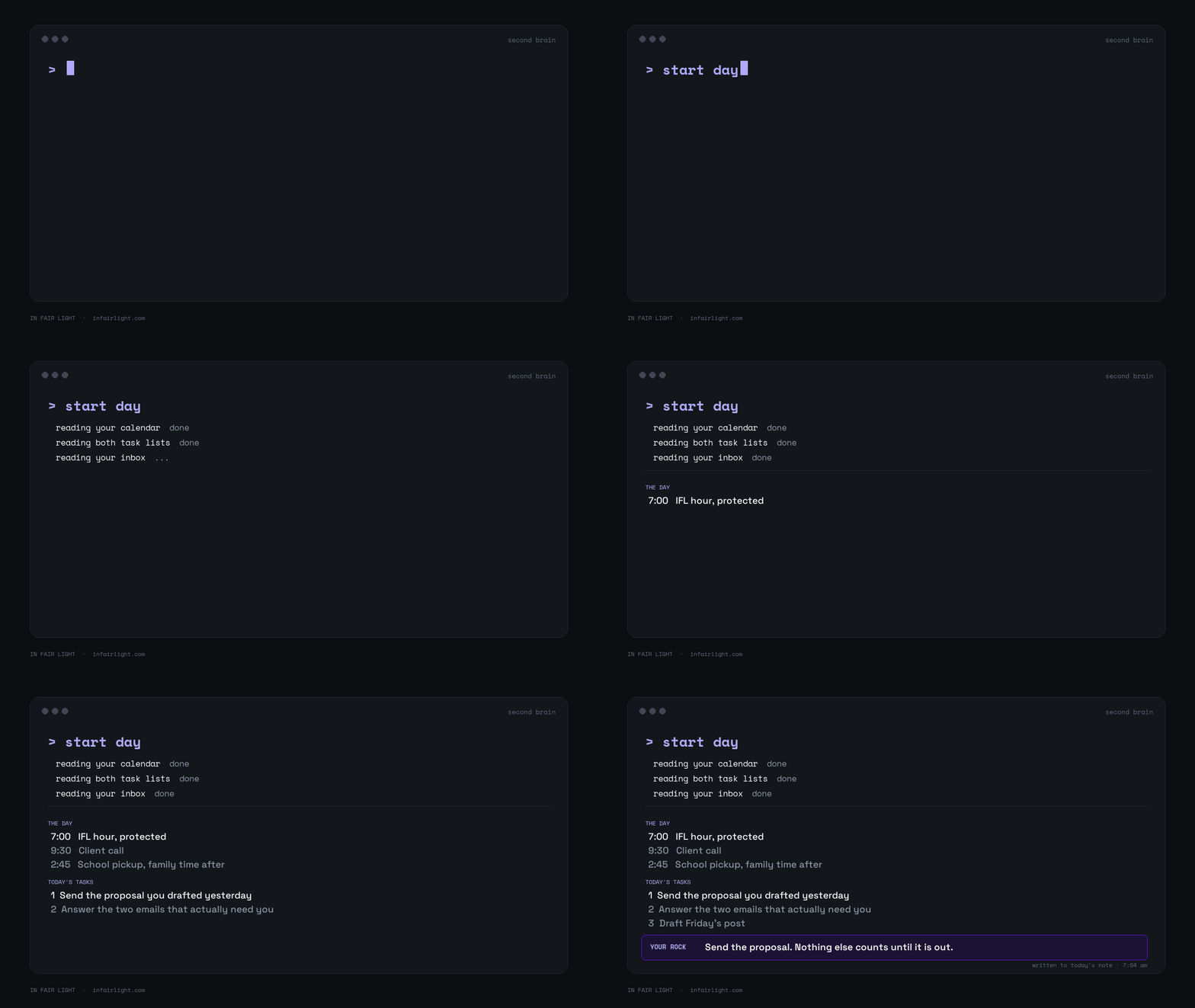
At 7:04 AM I typed two words into a terminal: start day. What came back was my day, already planned. Calendar, every task ranked, the three emails that needed an answer, and one line naming the single thing that would move the business today.
I built this because I was explaining my own business to an AI four times a day and getting a stranger back every time.

This post is the plain version of what a second brain for agency owners is, how In Fair Light runs on one, and what it changes. No setup weekend. That comes in a later post. There's a short PDF at the bottom you can keep or hand to someone.
What a second brain is
A folder of plain text files that holds everything your business knows: clients, decisions, processes, people. An AI assistant reads and writes those files directly. The notes are the memory. The assistant is the part that acts on them.
The name undersells it. When I say "second brain" to a business owner, their face stays polite. When I say "an AI that remembers everything about your business," they lean in. Same system. One is a concept, the other is a promise.
Three things it isn't:
- Not a note-taking method. PARA and Building a Second Brain are the lineage, and they're good. But they're about where a human files things. This is about giving a machine something to read.
- Not a chatbot with a longer memory. A chat history is a transcript. This is a record that gets maintained, cross-linked and corrected by an assistant whose standing instruction is to keep it true.
- Not a wiki. A wiki knows things. It can't do anything. The half people skip is the half that acts.
The four layers
Four pieces. Only one of them is hard, and it's not the one people expect. Tap a layer.
[[stack]]
- The vault. A folder of markdown files. At the end of August mine held 2,636 notes, about 5.3 million words, and 25,289 links between them. Markdown opens in anything and outlives any company. I look at it through Obsidian, but Obsidian is a window, not the thing.
- The rules file. One document at the root of the folder that the assistant reads in full before every conversation. Who I am, how the business works, my clients spelled correctly, what it must never do. Mine grew from forty lines to almost nine hundred. Then I cut it to about two hundred: one line per rule, with the reasons moved into their own file. This is the entire product. Folder structure is an afternoon. The rules file is months of catching your assistant being wrong and writing down why.
- The agent. I use Claude Code, an AI that runs in a terminal and lives inside the folder, so it opens, writes and reorganizes files itself instead of telling me what to type. Most setups stop one step before here, and it's the step that matters.
- The connections. The Model Context Protocol, or MCP, lets the assistant reach outside tools. Mine reaches my calendar, my email, my task lists, my design files and my website. Everyone wants to start here. Add it last, one connection at a time.
No vector database, no embeddings pipeline. For a business of my size that was solving a problem I didn't have. Five million words, well organized, is enough when the assistant can navigate rather than guess.
A working day on it
[[timeline]]
- 7:04 AM Start day. It reads my calendar, my task lists, my inbox and my goals file, then writes a ranked plan to the top of today's note, sized to the six productive hours I get, with one item marked as the rock.
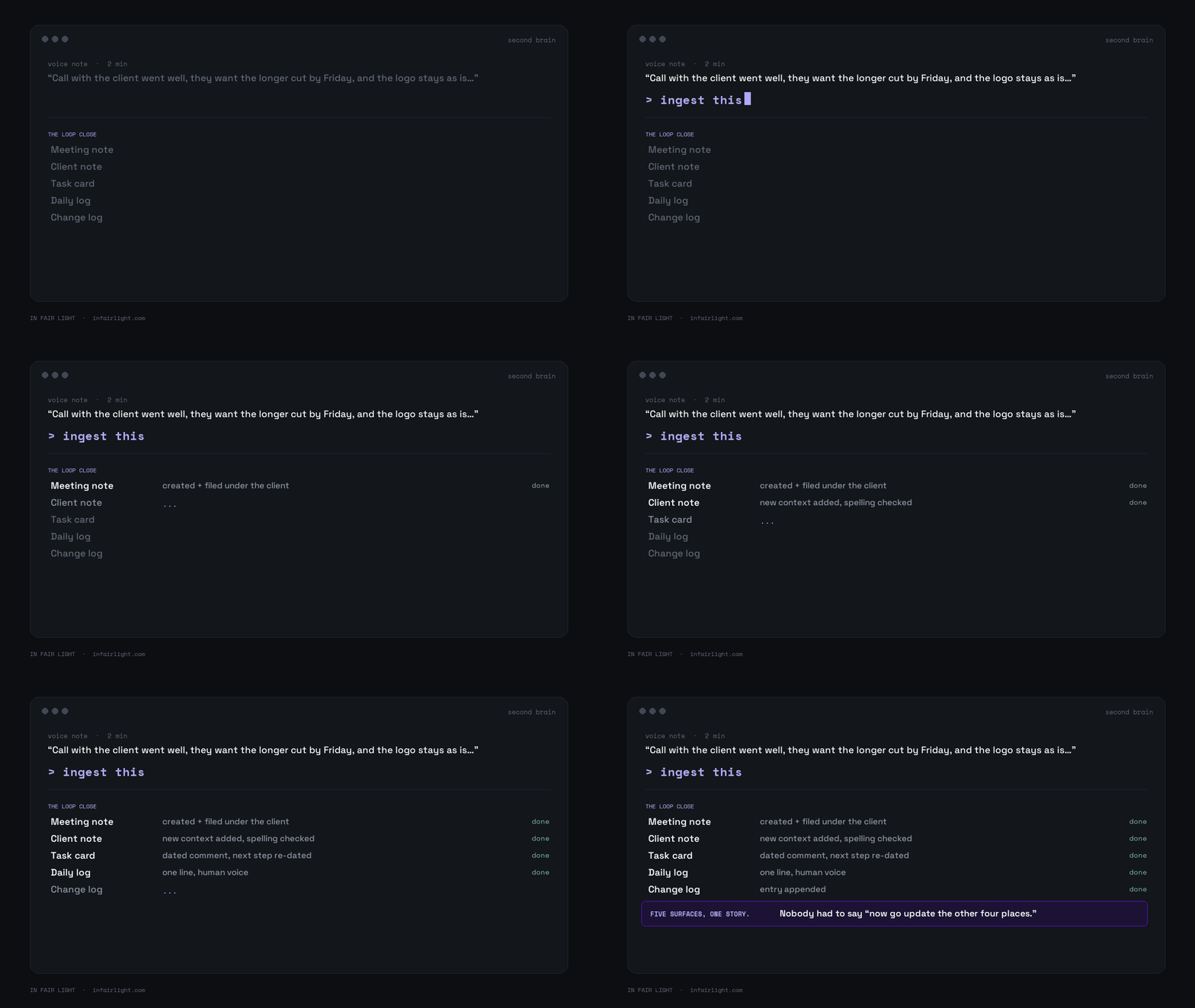
- 9:30 AM A client call. Afterwards I dictate a rambling two-minute summary into my phone and say ingest this. A meeting note gets created and filed. The client's note gets the new context. The task card gets a dated comment. Finished tasks close. Today's log gets a line. I call that bundle the Loop Close, because I got tired of saying "now go update the other four places."
- 11:00 AM Real work. It doesn't make the calls. It handles the execution and the twenty minutes of rebuilding context before it, and I spend the time I get back on ideas and judgment. The brand guidelines, the last three rounds of feedback and what we agreed about the logo are already in the prompt because they're already in the folder.
- 2:45 PM School pickup. Before I close the laptop I hand the agent one job that takes an hour and doesn't need me in the room. My kids get the afternoon and there's still progress in the business.
- Friday A weekly review that reads the whole week, writes one synthesis note, then asks me exactly three questions. My answers get written back into the rules file. That write-back is the entire compounding mechanism. Without it you have an expensive diary.
What changed
Three things changed.
Nothing gets re-explained. There's a decision log with every real call I've made and the reasoning behind it, including what I rejected. "What was I thinking when I made that call?" now has a written answer.
The cut leaves a trail. One night in August the content system generated 45 concepts and I approved 12. A 27% keep rate, which I only know because both numbers got logged.
It doesn't flatter me. The review of one of my biggest build weeks opened by noting that forty hours of campaign work was sitting unlaunched because ten minutes of clicking in a settings panel hadn't happened. A system that flatters you is one you stop reading.
Where it broke
Here's the failure that taught me the most.
A warm prospect asked to see it. I showed him the whole thing: the link graph, the dashboards, the queue of skills. He said, roughly, this is too much, I'm out. The same week an engineer running a software business watched the same demo and didn't convert either: too big, it would slow me down. A third person, on the same day, told me the thing had to be packaged as something other than a second brain. Three people, three different relationships to the product, and I reached the same instruction from each of them inside seventy-two hours.

Show one small thing that needs no explanation. Never the graph. The graph is impressive to me because I built it. To a buyer it's a picture of how much work they're about to be handed.
That's why this post has a three-page PDF at the bottom and not a forty-tab tour.
[[cta:Keep this|The Second Brain, explained on three pages.|A branded PDF you can print, forward, or hand to a partner who keeps asking what you're on about.|Get the PDF|#downloads]]
What it costs
- Obsidian: free for personal use. The folder itself is free. It's a folder.
- An AI subscription: roughly $20 to $100 a month. This is the whole software bill, and you're probably paying it already.
- The connections: free config files.
The real cost is the rules file, paid in attention rather than money. A weekend gets you something that runs. About a month of noticing when it's wrong and writing down why gets you something better than doing it yourself. That's the honest number.
Frequently asked questions
What is an AI second brain for a business?
A folder of plain text files holding everything your business knows, with an AI assistant that reads and writes those files directly, so it starts every conversation already knowing your business.
How is it different from ChatGPT or Notion?
A chatbot forgets between sessions. A wiki remembers but can't act. A second brain is both halves joined: a durable record the assistant can read, plus permission to write to it and keep it current.
Do I need to be technical?
No, but you need to be willing to spend about an hour in a terminal, once. The hard part isn't technical. It's writing the rules file, which takes judgment about your own business rather than code.
Where does the data live?
Plain markdown files on your own machine, in a folder you own. No vendor holds it. You can move the whole thing to a different AI tool by pointing that tool at the same folder.
How long before it is useful?
Useful in about a week, once one daily ritual is running. Compounding at around three months, when there's enough written down that it starts answering questions from your own history.
Can In Fair Light build one for me?
Yes. We build them for owners, agencies and consultants: your files, your subscription, no lock-in. It starts with a twenty-minute call, and if building it yourself is the right answer, we'll say so.
Want one for your business?
Four years of notes, three months of an assistant that can read them. I'm not early to this. Most people just haven't been shown the smallest version of it yet.
If you want yours built, book twenty minutes. No pitch. Next post: how to build one yourself, in five steps.
Take this with you
Downloads from this post
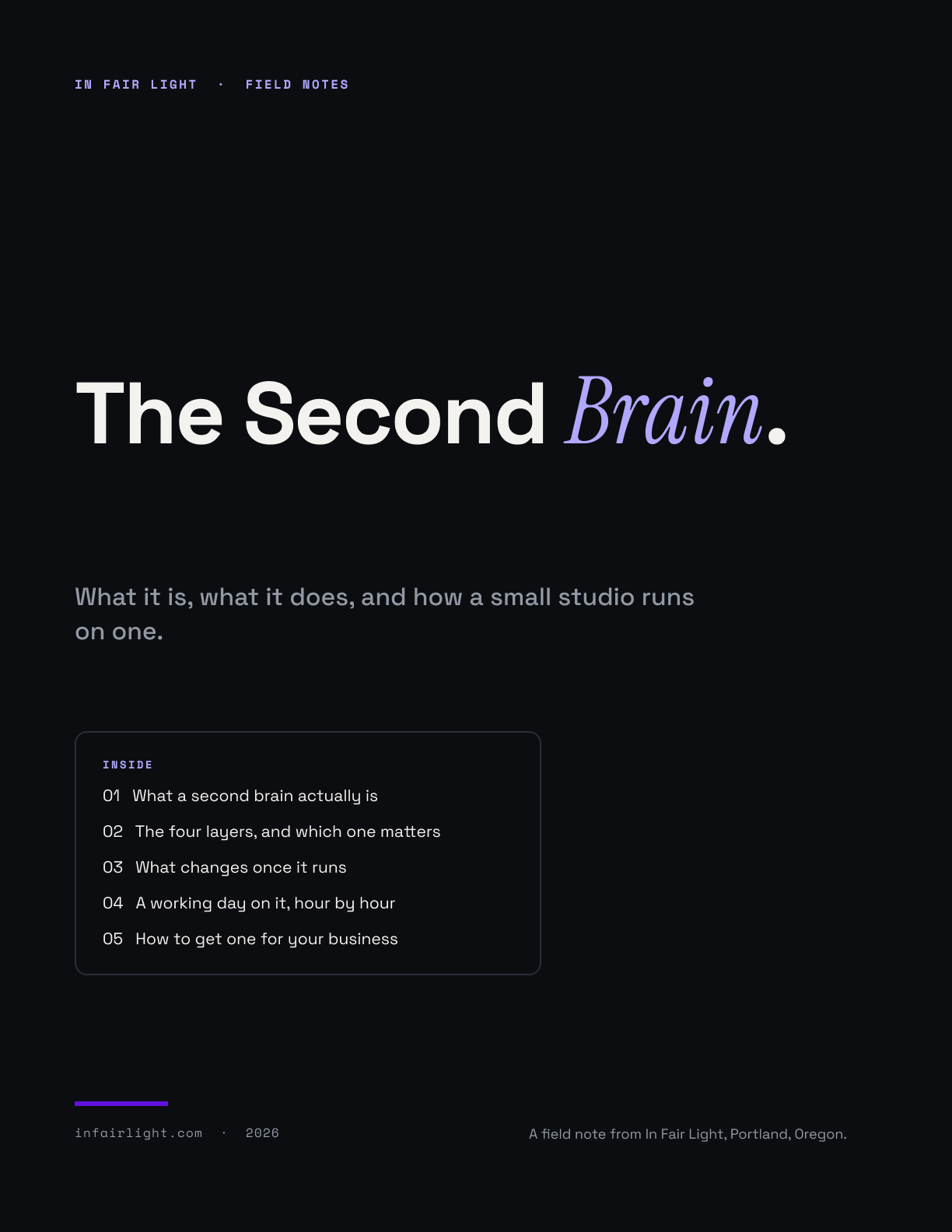
The Second Brain, explained
Three pages, branded, printable. What a second brain is, the four layers, what changes once it runs, and a working day on it. Hand it to the partner who keeps asking what you are on about.